
Tag: Sewing
How to sew on the centrepiece of a biscornu
Have you ever sewn a crystal or a button in the centre of a biscornu…? If so, then chances are you’ve experienced the frustration of 2 hands being insufficient to pinch the biscornu down AND stitch the centrepiece on tight enough! Here’s a way to do achieve this, easy peasy lemon squeezy style 🙂
You know what I mean: you squeeze the nicely stuffed biscornu in the centre, and as you get to stitch the crystals together, you HAVE to let go sooner or later to thread a crystal on, and pfffffffew the wretched thing puffs itself up again! It’s a battle of wills. And I don’t do sweating over a battle of wills against a biscornu: somehow, it doesn’t sound very heroic, does it!
So here’s a way to do it, without breaking a sweat 😉
1. You need a biscornu, a couple of crystals (buttons, or any other decoration you wish to use), and some polyester thread as stranded cotton isn’t strong enough for this job:

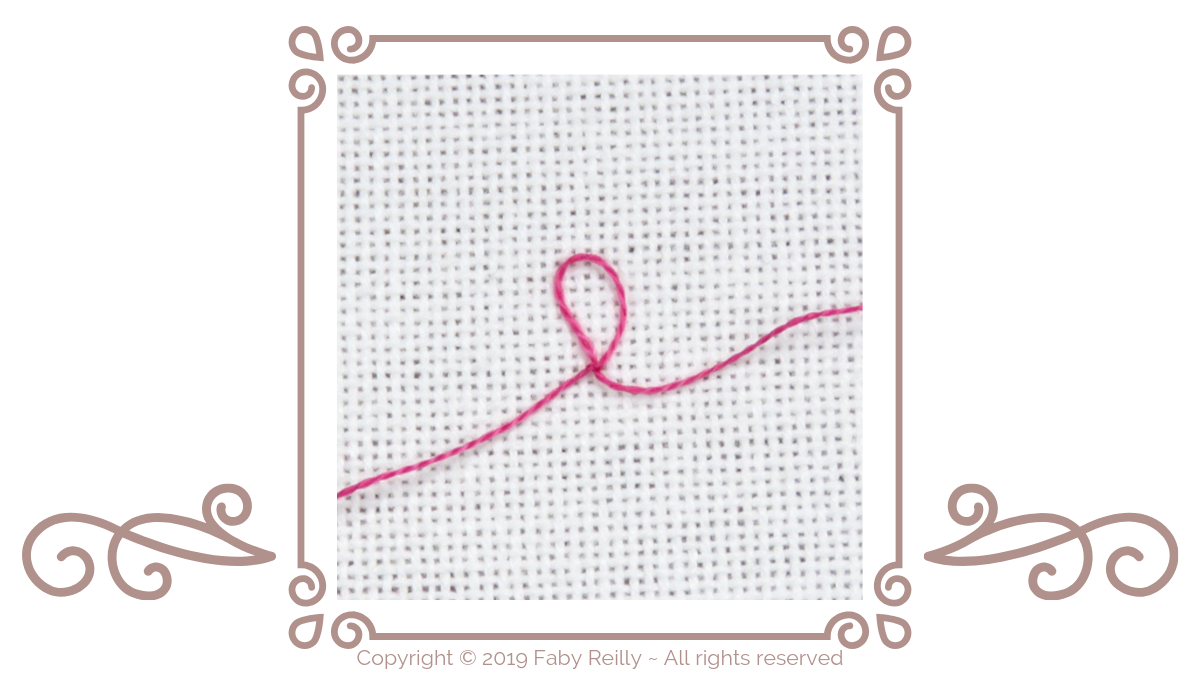
2. On one side of the biscornu, find the centre. Use the loop method to attach the thread over a good few strands of fabric (if all the pressure is on a couple of strands only, they risk tearing):

3. Pinch the biscornu in the centre with one hand, and stitch through to the other side with the other hand (keep going back and forth a good 3 or 4 times) WITHOUT using the crystals! Make sure the hollow is nice and deep. Then still holding the biscornu with your left hand (or right hand if you’re left-handed), give it a few loop knots to stop the thread from becoming loose again. Now, you can let go!! And don’t worry if it looks a little messy in the centre – we still have to attach the crystals which will hide any imperfection 😉

4. Now that you’ve so easily won the first battle (what a smug feeling!), you’re ready for round 2: sew on the crystals, one on each side. You don’t even need to sew them on super tight, as the biscornu will retain its shape no matter what, now. You just need to make sure they don’t wobble about. And when you’re done, give the thread a couple of loop knots again, under the crystal, and push the needle out as far as you can, away from the crystal:

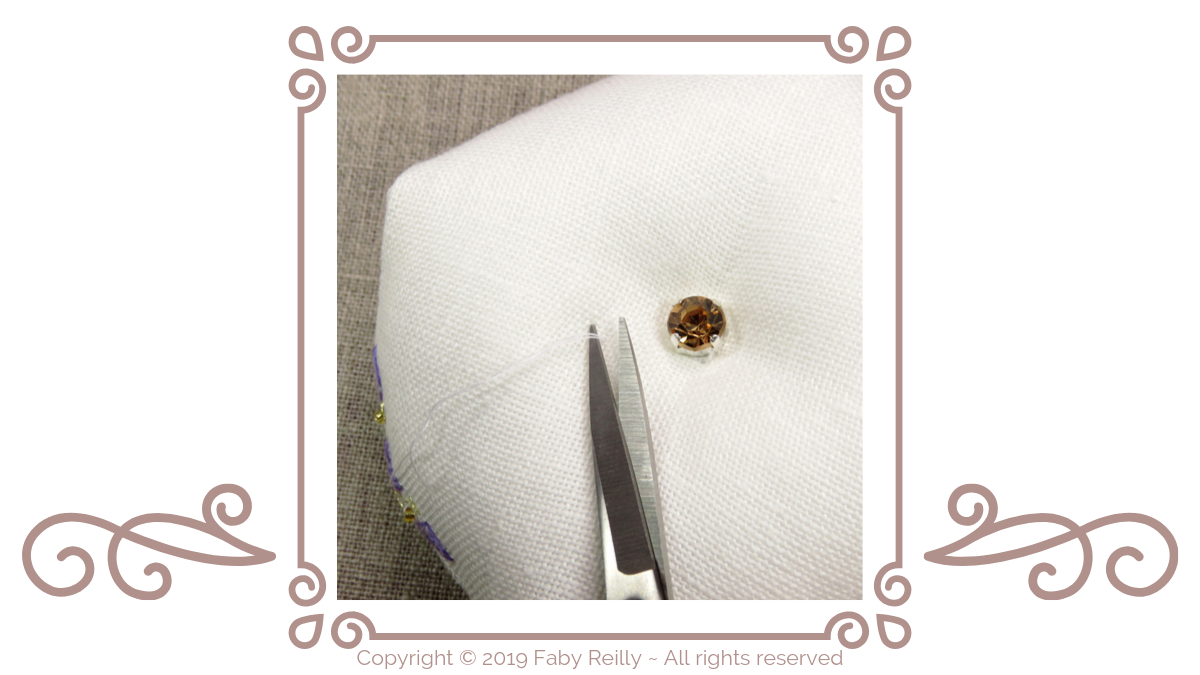
5. Pull the thread, and at the same time, snip it as close to the fabric as possible. Once cut, the thread will spring back into the biscornu and remain out of sight. Perfect!

[I know, I couldn’t hold the thread AND the scissors AND the camera, so I did have to let go of the thread – but you make sure you pull it tight, though 😉 !! ]

There, didn’t I tell you? Easy peasy lemon squeezy 😉
A few design ideas you may like, for which this method works really well:


How to stitch the outline of a biscornu
If you’re stitching something that has to be assembled biscornu style, and you hate having to count those endless stitches to make sure your square IS STILL a square by the time it’s done, then here’s a really cool trick for you!
That dreaded backstitch outline. Often stitched white on white (some designers just don’t have any consideration for their stitchers, do they 😉 !! Ooops, so sorry… really 😉 !) How are you supposed to see those stitches, never mind count them!? And if you make a mistake at the start, you’ve had it, and you’ve got to do it all over again… Grrrr… Been there too, don’t worry. I model stitch my own designs 😉 !! You wouldn’t believe how many times I’ve had to start over again. Usually that involves a fair amount of swearing…
So I tried concentrating better… no chance. I did NOT try drawing the grid on the fabric with those funky pens that vanish (my faint heart wouldn’t take it, should those lines fail to fade or should they somehow come back to haunt me…!!). I tried stitching a single strand of contrasting thread every 10 stitches… and decided it was way too much hassle to have to stitch 2 outlines, one of which was going to have to be taken out at the end anyway… what a waste of time! And that’s when it hit me:
WHY ditch the second outline!?
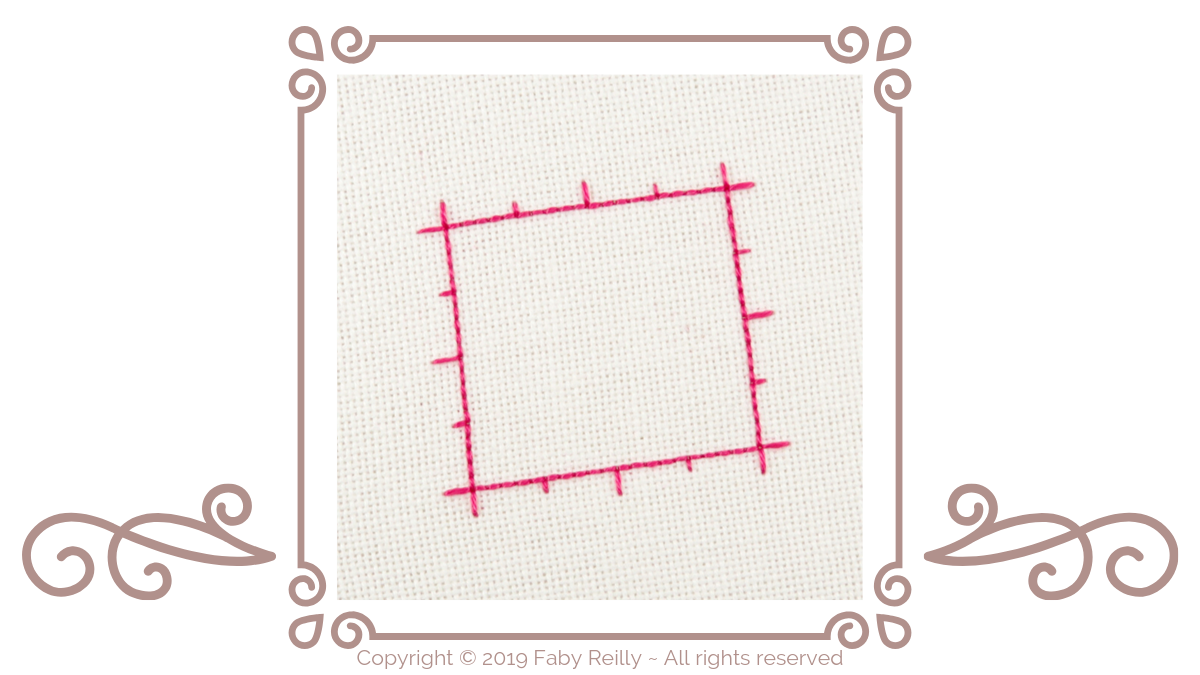
Those graduations are really useful even when you’ve finished stitching and you’re assembling the biscornu (or humbug, or whatever else). Fair enough, we can’t keep a contrasting thread in there, because it’ll show, so you see what I’m getting at? That’s right, a 2-in-1 solution 🙂 You stitch the graduation AND the backstitch outline TOGETHER, on the outside, so it doesn’t show when assembled, and you don’t have to unpick it!!! Winner 🙂 !!
Here is goes:
1. Use the loop method (explained HERE) to start your backstitch line, and begin with a vertical stitch (over 4 strands of fabric). Then stitch 5 normal backstitch stitches:

2. Stitch 1 vertical stitch (over 2 strands of fabric). That’s your 5s marker:

3. 5 stitches later, stitch another vertical stitch (over 4 strands of fabric), that’s your 10s marker. Etc… You’re basically stitching a ruler 🙂

4. And you keep going until you’ve finished the outline!! To stop the backstitch outline, you can use the method explained HERE.

Those graduations will be there the whole time to help you assemble the biscornu (quite useful when you have to find the EXACT middle of one of the sides 😉 !!!), and they’ll be hidden inside the hems, once assembled.
A few design ideas you may like, for which this outline method works really well:
-
 Naughty Kittens Glasses Case pattern
 -
 Zoe Pincushion & Weights SAL pattern
 -
 Christmas Gnome Glasses Case pattern
 -
 Thanksgiving Gnome Glasses Case pattern
 -
 Olive Tree Biscornu pattern
 -
 Butterfly Wreath Biscornu pattern
 -
 Bon Voyage Mini Suitcase pattern
 -
 Anchored in the Sand Glasses Case pattern
 -
 Sun & Moon Biscornu pattern
 -
 Festive Ribbon Humbug patterns
How to stop a lone stitch
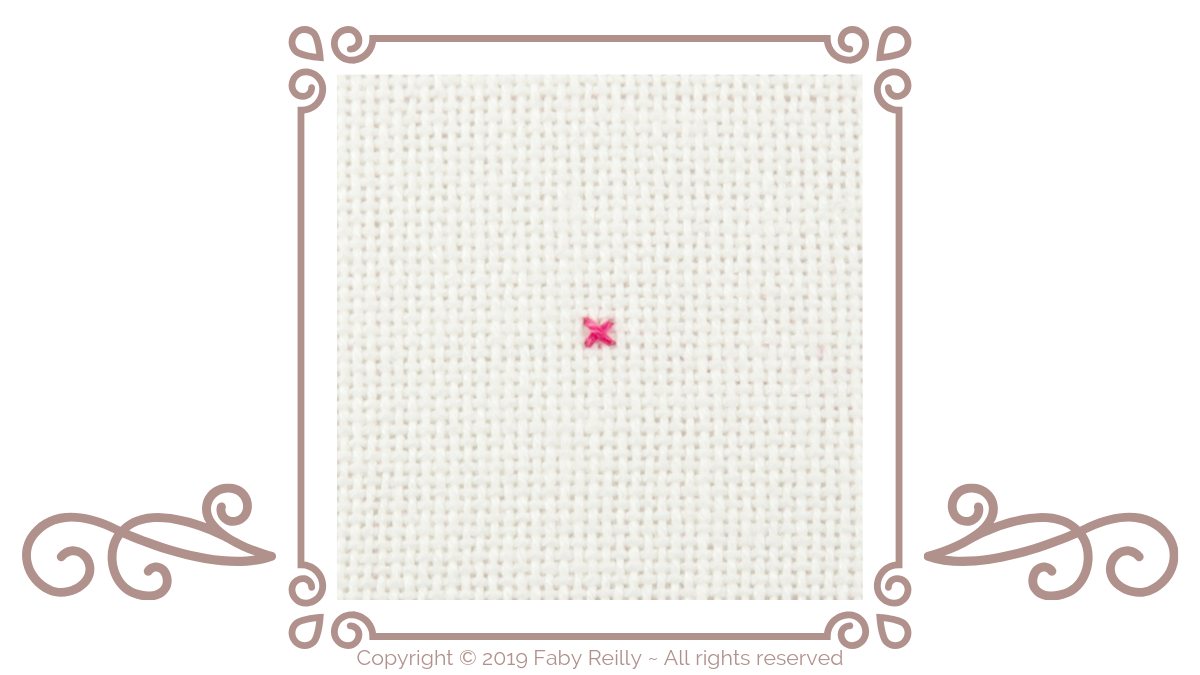
If you’ve ever had to stitch a pesky stitch that stands like a Billy No-Mates in the middle of nowhere, you’ll know how tricky it is to start and stop it, without having anywhere to anchor your thread to.
Here’s a quick and easy way to do it 😉
Meet the culprit:

1. You want to start it using the loop method (explained HERE), that way there’s no mess on the back of your work. And if you’ve done it right, it should look like this (from the back):

Pretty neat, isn’t it?
2. Now to finish it. So we’re staying on the back of the work. Push the needle through the back of the stitch:

3. Pull it, until you get a little loop, and then push the needle through the loop.

4. That’s going to create a little knot. Pull it tight.

5. And do the same again, so that you have 2 knots. Pull them tight.

6. Then simply push the needle through the back of the knots again.

7. And snip the thread off. (I haven’t cut it too close here, so that you can see where it’s snipped, but you don’t have to leave it so long 😉 !)

And the best thing is…♥… it works with anything! You can use this method to stop a line of backstitch, and I even use it at the back of each bead I stitch, to make sure it doesn’t become loose and start drooping.
How to apply interfacing… without risking your iron’s life!
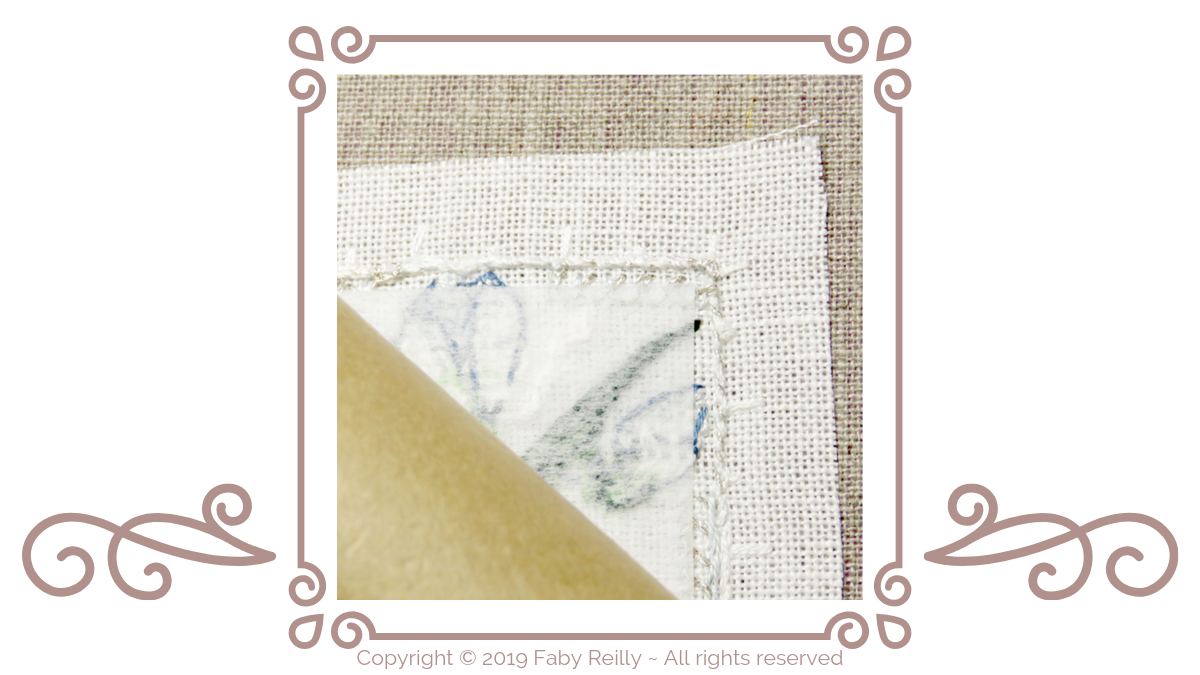
If you want to apply fusible interfacing with complete piece of mind, you need to use baking paper. Yep, that’s right. Baking paper.
Have you ever seen what the sole of an iron looks like if it’s been accidentally applied to the WRONG side of the interfacing sheet…? Well, you don’t want to, honestly. You either have to spend hours cleaning your iron, or you transfer glue onto all your clothes for the following month, … or you give up and buy a new one (eeek…!)
Accidents happen, right? Can you really be 100% sure you’ll NEVER be distracted by a phone call, or a text, or a “is tea ready yet?”… and that you’ll NEVER place the interfacing glue-side up…? I’m not.
So there you have it. Baking paper is your friend. It withstands LOTS of heat, so it’ll cope with your iron, and if EVER the worst happens and you place the interfacing the wrong way up, the baking paper will be happy to take the rap for it (it’s much cheaper to replace than an iron!!!)
1. Layer the stitched fabric (wrong side up), the interfacing (sticky side down), and last but not least the baking paper:

2. Iron the baking paper, then gently peel it off:

And you know what, even if you’re always careful, and NEVER get the sides mixed up… it’s STILL a great idea to use baking paper: there’s often a tiny amount of glue that bleeds past the edges of the interfacing… only a tiny amount, but enough to make your iron irritably sticky for a short while!
Extra tip, because I ♥ you:
If you use the same baking sheet more than once (only if it’s not been in a wrong-side accident, OK?), write something silly like “iron side” in one corner of the side that’s never been in contact with the interfacing, otherwise you’ll contaminate your iron with the glue bleeds from the previous time you used the baking sheet!

And now: ready, steady, apply stress-free interfacing!
A few design ideas you may like, for which this outline method works really well:


